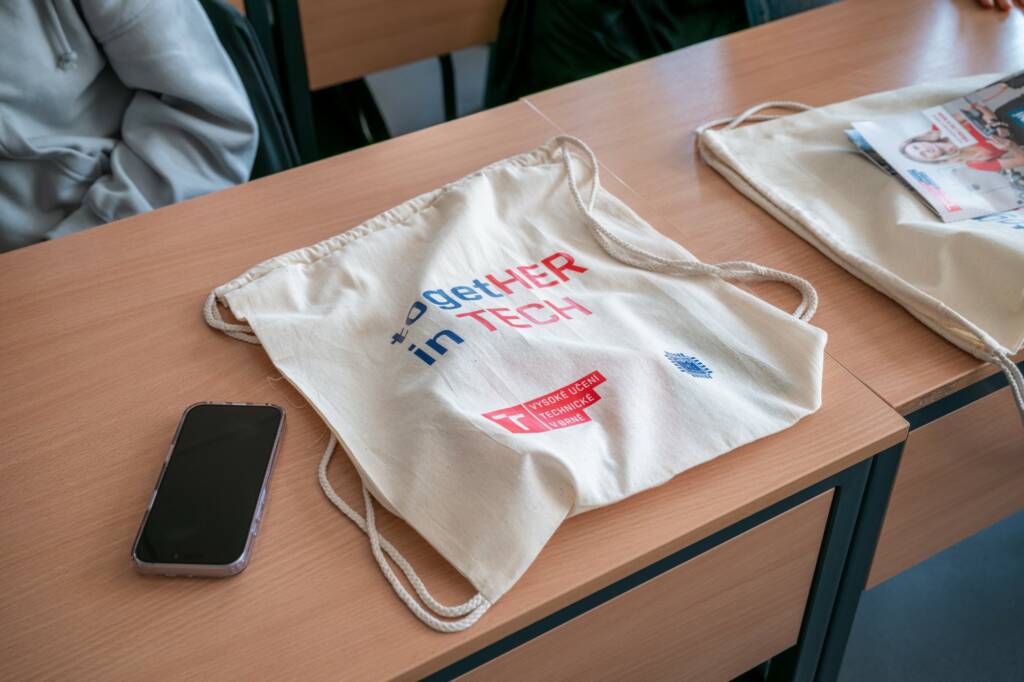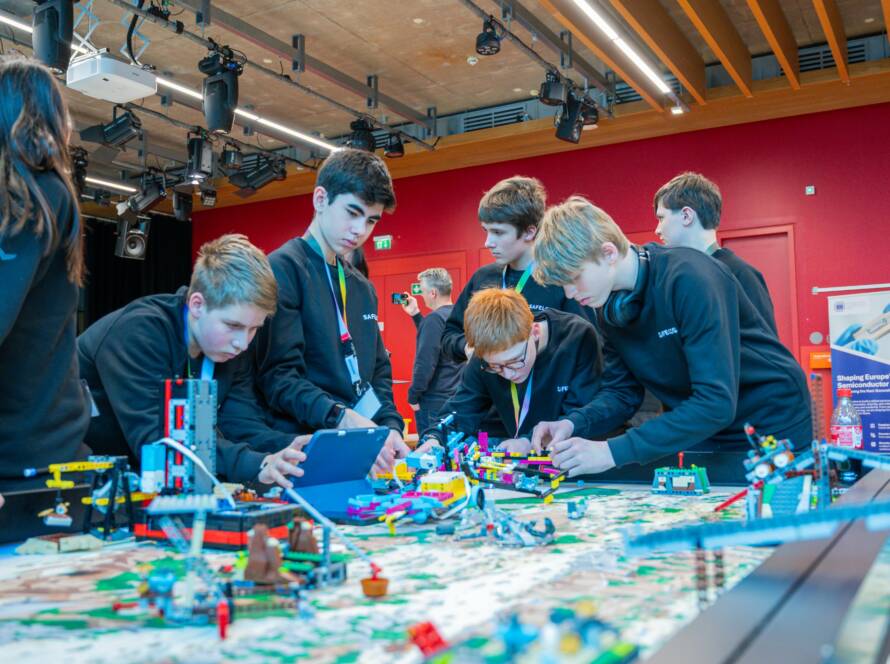

Brno, April 15 – Last year, Brno University of Technology (VUT) launched the first edition of togetHER in tech, an outreach event designed to support women in technical disciplines. Thanks to its strong impact and engaging programme, the initiative was adopted this year by nine European universities and companies as part of their efforts to encourage young women to pursue studies and careers in technology. Soon after its launch, the event has become a strong example of how European institutions can successfully collaborate within the CHIPS of Europe initiative.
A Brno initiative with European reach
The second edition of togetHER in tech took place during the week beginning 23 March 2026 and was held across seven European countries. Participating institutions included Infineon Austria and Infineon Germany, both active in semiconductor manufacturing; Hochschule München in Bavaria; the University of Southern Denmark; the University of South-Eastern Norway; Université Paris-Saclay in France; the Technical University of Sofia in Bulgaria; EnduroSat, a Bulgarian space technology company; and Brno University of Technology (VUT) in the Czech Republic, where the concept was first introduced last year.
The idea developed in Brno has since inspired other members of the CHIPS of Europe consortium, which organised togetHER in tech in both 2025 and 2026. The project aims to strengthen semiconductor education in Europe and help European countries become more self-sufficient in chip research, development, and manufacturing.
Part of a broader European education strategy
Within the CHIPS of Europe project, togetHER in tech is part of Work Package 4 (Activities Targeting Secondary Schools), which focuses on educational development and cooperation with secondary schools. More specifically, it is included under Task 4.2 – GirlsGoDigital.
This year, the event expanded from Brno to a wider European audience thanks to GirlsGoDigital coordinator Julia Calabrò and her colleagues, who prepared an organisational handbook for participating institutions.
“The first edition of togetHER in tech received very positive feedback, so we offered our format, including the name, to Julia Calabrò from Infineon Technologies Austria. Our goal is to unify support for women’s education in technical fields across Europe and to connect them,”
said Ing. Katarína Rovenská from the Faculty of Mechanical Engineering at VUT, who created the original concept for the event.
Inspiring girls to explore STEM early
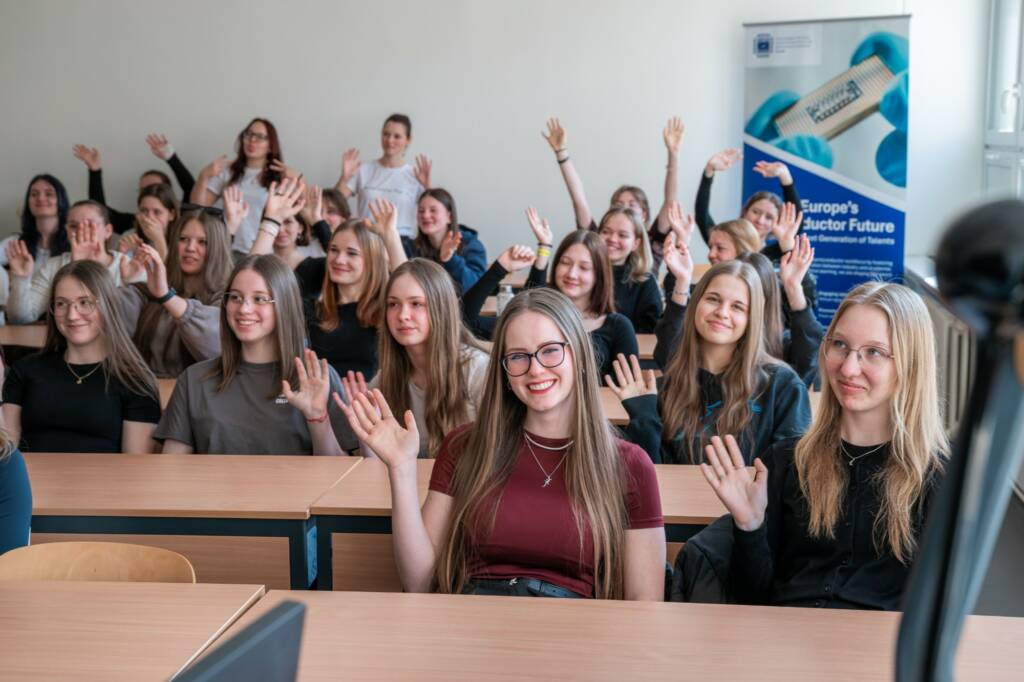
TogetHER in tech is aimed primarily at girls from secondary schools and multi-year grammar schools, though it is also suitable for younger students. Research and experience show that interest in STEM subjects often begins to form between the ages of 10 and 16. Early encouragement, visible role models, and practical experience therefore play an important role in shaping future career choices.
At a time when the semiconductor sector is facing increasing demand for qualified professionals, promoting diversity is not only a social priority but also a strategic necessity. This is one of the main reasons why togetHER in tech has grown beyond the Czech Republic.
“We organized the Chips of Europe ‘togetHER in Tech’ event to bring girls from all over Europe together and inspire them to pursue careers in tech. It was amazing to see the power of community in action — one of the highlights was our global power call, which connected the girls to a movement that’s bigger than just their local communities. We’re passionate about growing the female tech community and creating a more diverse and inclusive microelectronics industry, and we are very much looking forward to hosting another event in the future, where we can continue to inspire and empower even more girls,”
said Julia Calabrò from Infineon Technologies.
Combining theory, hands-on learning, and role models
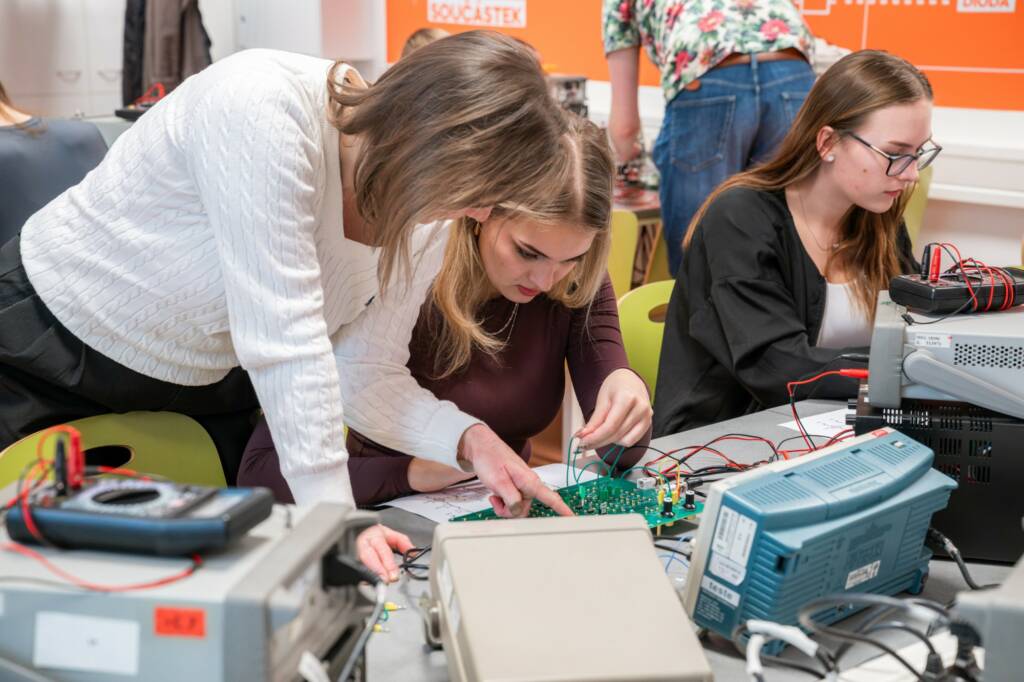
One of the strengths of togetHER in tech is its combination of theoretical and practical activities. In the Czech programme, participants met women already working in technical fields and attended a lecture on rotational dynamics and rolling motion. Practical workshops then gave students the chance to try activities such as soldering, assembling electrical circuits, and working with an atomic force microscope.
Both parts of the programme were met with enthusiasm by the participating students. In Brno, where the event took place at the Faculty of Mechanical Engineering (FME) and the Faculty of Electrical Engineering and Communication (FEEC), participants especially valued the practical sessions and the morning discussions with female students and professionals in technical fields.
“I liked hearing from students and graduates about how they got into their studies, and that it doesn’t have to be something you’ve loved since childhood. There are many different paths,”
said one of the attendees in Brno.
Challenging stereotypes in technical education
According to another co-organiser, Ing. Veronika Junasová from FEEC VUT, raising awareness that women belong in technology remains essential.
“There is a shortage of women in technology, and we especially see this in electronics. Yet there is no evidence suggesting that women are not capable. It is more about persistent stereotypes. Among girls, we often see comparisons with boys and societal expectations influencing them. We need to change the perception of society, parents, and teachers to show girls that technology is not just a male field.”
Growing participation across Europe
More than 100 secondary school girls took part in the event across Europe, including 39 students from 15 schools in Brno.
“Compared to the pilot year, we had significantly more participants at VUT this year. It shows that secondary school girls are interested in technical fields, which makes me very happy,”
said Katarína Rovenská.
Looking ahead to future editions
The organisers already see clear potential for further development. According to Veronika Junasová, future editions at VUT could include separate lectures and workshops at individual faculties, allowing girls to explore a wider range of technical disciplines in more depth.
Positive feedback from participants — many of whom said they would recommend the event to their friends — also supports the idea of continuing togetHER in tech next year.
Julia Calabrò shares that enthusiasm:
“We are excited to further develop the community of women in technology and contribute to creating a more diverse and inclusive environment in microelectronics. We are already looking forward to the next edition, where we will be able to inspire and support even more girls.”
Contact:
Assoc. Ing. Jiří Háze, Ph.D.
Vice-President for Academics, Czech National Semiconductor Cluster
CEO, Advanced Chip Design and Research Center
e-mail: haze@vut.cz